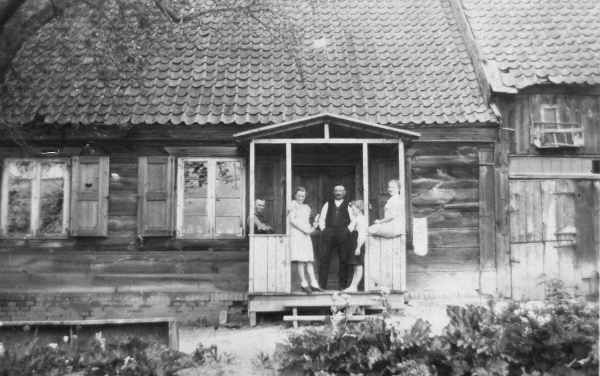
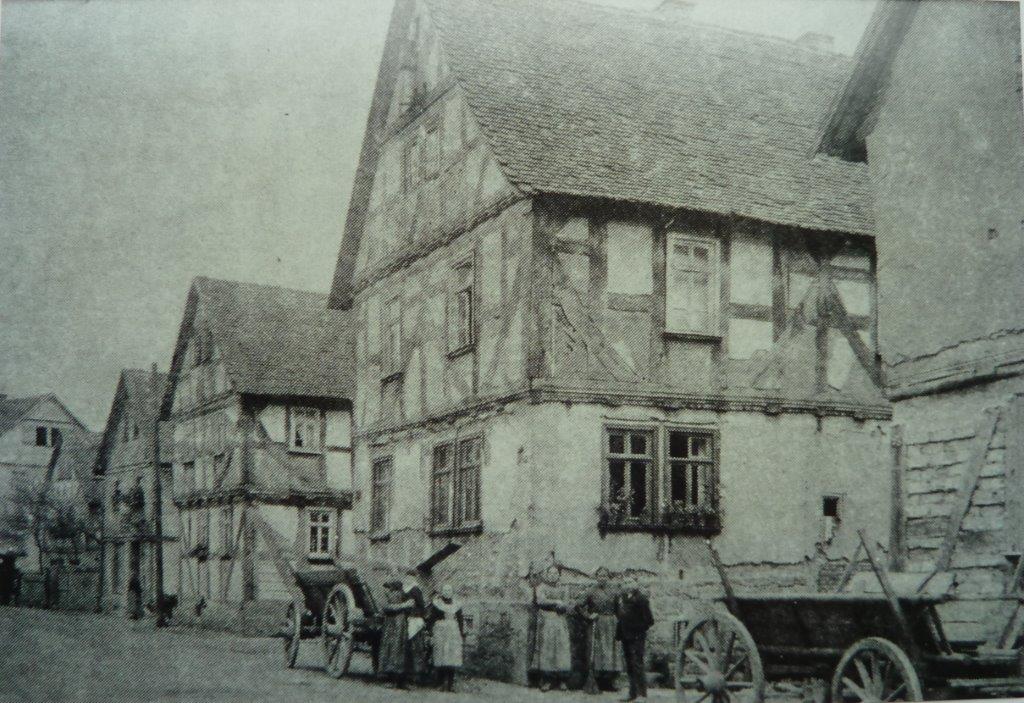
In Zeyervorderkampen during and before World War 2, there was a small Käserei (Meierei) Dairy that was owned, all or in part, by Richard Senger.
Based upon maps and analysis of the region (today Kepiny Male) by Rainer Glodde-Mueller during his 2010 journey to the area, it is believed that the following photos are what remains of that past business. Obviously the buildings had been worked on in the early 1950s (see the photo with the dated stone near the roof peak).
Discussions with Luise Senger Rabideau (Richard’s daughter) were not definitive in identifying these buildings positively. A mystery remains. Are these, or are they not, the buildings that once housed the Papatschen Käserei (Meierei)…
Polish courtesy of Google Translate:
W Zeyervorderkampen w trakcie i przed 2 wojny światowej, była mała Käserei (Meierei) mleczarskich, które było własnościąwszystkich lub części, Richarda Senger.
Na podstawie mapy i analiza regionu (dziś Kępiny Male) RaineraGlodde-Mueller podczas jego podróży do 2010 na obszarze, uważa się, że poniższe zdjęcia są co pozostaje, że w przeszłościfirmy. Oczywiście budynków została opracowana w na początku 1950 (na zdjęciu z dnia kamień w pobliżu szczytu dachu).
Rozmowy z Luise Senger Rabideau (córka Ryszarda) nie byłyostateczne w identyfikacji tych budynków pozytywnie. Tajemnicapozostaje. Czy te, lub nie są one, budynki, które kiedyśznajdowały się Papatschen Käserei (Meierei) …
Does anyone have access to West and East Prussian German recipes? I would like to gather a collection of food recipes that were local to the Germans who once populated the region of Europe between Danzig Marienburg, and Koenigsberg.
Please contact me directly with any recipes or food names that you might have/ remember. I will eventually place everything I gather in a database here for all to see, read and copy. I suspect that might take a while and that assumes, of course, I obtain any recipes at all. But given it is the holiday season, and this is the time for foods, I thought I’d ask!
Happy holidays and enjoy your Koenigsberger Klops!
We have created our first twitter based online Newspaper (using paper.li). The ManyRoads Sentinel is now accessible via our new News! link on the top banner of ManyRoads. I hope you find the articles and news items both informative and useful. As time progresses, I will be tweaking the newspaper in an effort to achieve an optimal balance of items and news.
If you follow certain folks on twitter who you believe ought to be included in our paper, please let me know. In the meantime, please be advised that our paper is updated as both morning & evening editions. You may subscribe directly to the journal from the ManyRoads Sentinel page.
Of late, I have received numerous queries and comments from our readership regarding my position on and interest in the ethnic expulsions of German peoples from Eastern Europe after World War 2. I think this is a fair question that merits response.
I guess I would begin my response by stating that expulsions and holocausts (genocides) did not start nor end with the Germans of 1930-1940s Europe.
From a historical context some of the earliest genocides were (according to Wikipedia):
the destruction of Melos by Athens during the Peloponnesian War (fifth century BCE)
the genocides of Amalekites and Midianites (described in the old Testament).
the Yu Ding (禹鼎) records that Liwang of Zhou (d. 828 BC) ordered his army not to leave old and young of a rebel country alive.
the destruction of Carthage at the end of the Third Punic War (149–146 BC) “The First Genocide”.
Expulsions and ‘holocausts’ continue today and have been conducted with vigor for millennia.
In World War 2 alone there were at least four major ‘genocides/holocausts’ conducted against non-combatant civilian populations of:
Jews (up to 6 million),
Chinese (up to 16 million)
Germans (up to 3 million)
Polish (up to 2.5 million)
Other less easily classified WW2 ‘genocides/ mass murders/ displacements’ were conducted against the Soviet controlled peoples (Russians, Latvians, ethnic Germans, etc.), American Japanese, Indians, Indochinese, Indonesians, European gypsies, and homosexuals. Since World War 2, there have been numerous additional ‘holocausts’, including those against Cambodians, Bosnians, Rwandans, Sudanese…
The extreme sadness is that each event is inexcusable and more sadly, few are even remembered or acknowledged. Historically, governments and peoples continually attempt to rationalize and justify their genocidal crimes in the context of some prior crime, either real or imagined, that was perpetrated upon ‘them’ previously by the ‘other’. The cycle simply never ends. There is no first crime, there is no last retaliation. It is simply a vicious hate based spiral/ cycle. In human terms, the cycle is nearly infinite in duration and scope. As someone once said: “An Eye For An Eye Makes The Whole World Blind”.
So why do I bother to tell and document the Vertreibung story? I tell the story of the German Expulsions because my family was very fortunate to have survived the pogroms, murders, concentration camps, loss of property, etc. and because the Vertreibung bears telling. The Vertreibung was the largest ethic cleansing in history, involving the displacement of as many as 14 million people; the crimes against humanity in this event are immense and almost always ignored- especially by those most closely involved in their sanction and conduct. People need to be informed. The acts should be remembered in the hope that they will not be repeated. Most importantly, governmental or social ‘retribution’ meted out during the Vertreibung needs to be unconditionally viewed as inexcusable, unacceptable by anyone, anywhere. Crimes, genocides, expulsions such as these are unpardonable, even when they are conducted against a people who had the great misfortune of being associated with a hated and abjectly defeated government.
Our family, your family, every family has been wronged at one time or another. We have all, almost certainly, been associated with losing wars, being on the wrong side of an issue, and being expelled from homes and lands we thought were ours. Our families have been wrongly incarcerated and punished by people who believed they were superior to us. We have been punished for our language, our color, our intellect, our beliefs and more. No family is immune.
Fortunately each of us has a choice. We can choose to perpetuate, hide, ignore or excuse these events; or we can attempt to stop their continuance and recognize them for what they are: crimes against humanity.
I choose to tell the tale, and I refuse to continue the cycle. The Vertreibung, like many other expulsion/ genocides, needs to be viewed in the light of day. We need to examine it, evaluate it, and our reactions to it. We need to move forward by forgiving ourselves and others. In forgiving others, we free ourselves. In asking for forgiveness, we earn the right to be forgiven.
So, during this annual season of remembrance, love, peace, and forgiveness, I extend my fervent wish for broader understanding, acceptance, and tolerance. I hope you will join me in working for a world where we all can see and appreciate our shared humanity. A world where reconciliation is possible and we can forgive one another for our collective transgressions, while still valuing the sacrifices each of our families have made.
After searching for more than 70 years for documentary evidence, on 11 December 2010, we finally viewed the image of the birth record of Adelgunde Wilhelmine Senger geboren (born) Kiehl (my great-grandmother- “O-oma“). It was one of those ‘hoped for’ breakthrough findings. Earlier we had uncovered evidence on FamilySearch saying that her birth record was in fact located in Graudenz Mittelbezirk Westpreussen. Just about 6 weeks ago, we ordered the microfilm and sure enough, there it was. We now have the film on permanent hold in our local family history center in Parker.
Her birth was on the 6th of October 1850. Her father was Erdmann Kiehl and her mother was Esther Adelgunde Grindemann. There is additional information on the record we need yet to assess, including the name of her birth town (not very easy to read on the photo we currently have). We also hope to find evidence of her parents births, ideally in the same church/ area.
Happy Holidays! As we are now in the midst of the largest annual holiday season, I think it is time for me to quickly write and publish our monthly News Letter. As always, it is on our extraordinarily accurate, semi-irregular schedule.
The past month has been quite busy for me both from a genealogy/ ManyRoads website perspective as well as otherwise. It seems like I have been everywhere but home for most of the past month. Now with the holiday season, we ( Becky and I ) are busy with things in the family and otherwise, as I am certain everyone is at this time of the year.
This past month, I have been attempting to gather and publish a significant body of video and musical data; some materials were generated according to plan others came by circumstance and luck. The material has ranged from the sublime into perhaps even the frivolous. Hopefully, the materials help paint a somewhat clearer image of a small piece of the past, not to mention my personal feelings about the past. I sincerely hope most of you have found the materials informative, even if they have not been entirely enjoyable.
A number of very thoughtful and generous folks have sent us materials to share on the web during the last month. We greatly appreciate the ‘donations’ and will make them available as we are able. I would note that some of the items are not necessarily easy to upload and share. We are currently in process of receiving numerous “new to ManyRoads” pre-world war 2 address books from the former Eastern German provinces. We are very excited about these and will get them online as soon as we can.
Happily, our visitor numbers continue to grow and we are now averaging around 240 visitors per day! Last month we again topped 7000 visitors. We even briefly ranked in the top 25 of all genealogy websites tracked by genealogy.org.
Finally the list! Here are the ManyRoads items published during the past month or so:
As always, I want to request any/all of you who have genealogical websites please consider reciprocal linking with ManyRoads. There is no cost and both your site and ManyRoads will benefit from the links. Simply place a link to http://many-roads.com on your site; send me an email letting me know you have made the link; and, I’ll place a link to your site.
And last but not least: a very Merry Christmas/ Frohe Weihnachtsfest to all our Christian readers! and a Happy Holiday season to all!
Zwei Tage nach Kriegsende treiben tschechische Milizen deutsche Bewohner Prags mit brutaler Gewalt aus der Stadt. Es ist der Beginn der Vertreibung fast aller Deutschen aus der Tschechoslowakei.
This film details the history surrounding the expulsion of Germans from Prague, the Sudetenland and Czechoslovakia. Both the NSDAP actions and crimes preceding the expulsion and the brutality with which the ultimate German expulsion were conducted by the Czech people and government after the war are detailed.
Genealogical research is an uncovering of truths as they apply to your life, others’ lives, the past and the future. There never truly is a single answer to what happened, how it came to be, and what was best or worst. The options and answers are often many, complex and perhaps even indeterminate. Inter-dependencies, inter-relationships abound. However, applying the rule of six can be a useful tool in helping you attain insights into the past you might otherwise miss.
What follows is a brief description of the Rule of Six by Paula Underwood Spencer:
One of the attitudes taught in my [Oneida] tradition is the Rule of Six. The Rule of Six says that for each apparent phenomenon, devise at least six plausible explanations, every one of which can indeed explain the phenomenon. There are probably sixty, but if you devise six, this will sensitize you to how many there may yet be and prevent you from locking in on the first thing that sounds right as The Truth.
But your task isn’t over yet. Because you can’t just float on a multiple option basis. Now your task is to apply your life experience, which is unique to yourself, and use it as a base to evaluate each of those options. Now you assign a probability factor. That probability factor can never be 100% . . . and absolutely never zero.
You keep a floating attitude toward life, but you constantly know where you are in that context. [...]
If you are courageous and flexible enough to follow Paula’s advice, you will learn more than you can ever imagine about your past, your family, and perhaps even a little bit about how things became as they are…
We are building this sampler collection and hope to add more music as we find it. It is our plan to add tunes from the 1920′s, 30′s, and 40′s. Over the longer term, we hope to build a similar collection for US tunes as well.
I have attempted to present videos offering the music and feeling of WW2 Christmases in Germany. It is, as you might imagine, very difficult to find films that are not extremely propaganda oriented. Those presented here are more oriented to the music and mood of the time and less towards the propaganda, which is what I seek to portray here. If you know of films and music that are available for use, please let me know where to locate them and I will add them. More
This set of films documents the Battle of Verdun in which Richard Senger fought, was wounded and earned an Iron Cross 2nd Class. He served in the Prussian (German) Artillery. This is the same area where Adolf Senger was killed and is buried.
Sharing is a particularly wonderful aspect of human existence.
If you have found ManyRoads to be helpful in the conduct of your research during the past months, we ask that you briefly reflect on the wonder of your family, community and life. Please also take a moment to remember those less fortunate than yourself. In remembrance of those you love, we ask that you provide a small donation to those in need during this upcoming holiday season. We have placed a link in our side menu toOxfam’s Unwrapped program to facilitate access to what we believe is a very good charity (see the Oxfam Cow on the right and view the video below to learn more…). But by all means, feel free to choose another charity, if you prefer.
We would greatly appreciate a small note, email or comment letting us know of your intentions and actions. By working together and sharing our resources, we not only help each other but, we also contribute to the creation of a more peaceful and joyous existence for everyone.
“The privilege of a lifetime is being who you are.”
For some reason Christmas, this year, reminds me of WW1. I know it shouldn’t.
I have no idea why I am reminded of WW1- perhaps it is because I have been doing a lot of genealogy and I spend a lot of time thinking about the past. And, the past always reminds me of my Opa (Richard Senger). His life and mine have been deeply affected by the Great War (his directly.. mine vicariously).
I know a war is historically over at a definitive point in time, but emotionally that may not be the case. It seems more like waves… each following the other, getting smaller and shallower with time and distance. The pain of the Great War continues to ripple across time, still affecting me. His pain, his strength, his loss, all remain in my heart and remain real.
Which genetic genealogy DNA service is best? This is the question with which I am currently wrestling. Perhaps one or more of our knowledgeable readers has some insights to share. I certainly would appreciate experienced observations and insights into our dilemma.
Here are the basic objectives of our DNA search:
We’d like information and insight on any Native American information on the male Rabideau and female Deyo line (I do not currently have access to male Deyo DNA); we also seek information on the background of both lines in Europe and before.
We seek information on the Senger- Recht matrilineal lines; there is no DNA material available for either line on the male side, of which I am aware (the world wars took care of that…). This will be a search for European and pre-European migrations etc.
My assumption is that we ultimately are best served by having my father’s DNA run for both matrilineal and patrileneal lines (additionally examining both sides for Native American markers). We also ought to have my mother’s DNA run for our Prussian ancestry markers to check her matrilineal lines for European migrations etc.
If you have already conducted similar research…
With which services have you had good success/ positive experiences?
Are there obvious flaws in my plan?
What would you do differently from my plan or recommend I include in our search?
We have a list of links to the providers we have found on our Links page (see Genetic Genealogy). Perhaps we have missed some important players? Perhaps you can tell us which are best, based upon your experience(s)…
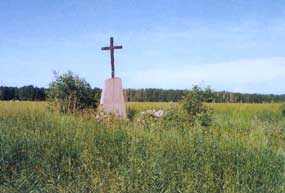
The cemeteries of the former Zeyer, West Prussia have severely deteriorated over the years. Clearly the destruction of the Zeyer ev. Kirche by Russian bombardment did the most complete removal of burial sites. But time itself has eroded the Zeyer Mennonite burial grounds as well.
The photos below are what is left of both the Lutheran and Mennonite Cemeteries (2010).
Lutheran Cemetery
All that remains of this burial ground is a marker placed there in 2009.
Recently a new Internet Expulsion (Ethnic Cleansing) Discussion Group opened its doors for business.
If you are interested in learning more about, or are researching, the European Ethnic Cleansings of the 20th Century as described below, these groups may be of interest. Hopefully the discussions will remain constructive as well as informative.
The European-Expellees Expellees * EUEEP * EUFV * UESE group describes itself as follows (click here to visit their site):
Flight, expulsion, ethnic cleansing, banishment and exile are fates suffered by millions of Europeans in the 20th century and represent a widespread political phenomenon in the world up to this day. This group is intended to serve as a platform to enhance communication and interaction between European refugees, expellees and people who support their rightful aims.
English, German and Italian are the official working languages of the European Union of Exiled and Expelled People (EUEEP). French will be permitted in this group as another major European lingua franca of high importance in the European institutions.
A second group, more narrowly focused on the German Expulsions from the former German Eastern provinces, describes itself as follows (click here to visit their site):
[The group focuses on discussions and information about ]Expulsion of ethnic Germans after World War 2.
The expulsion of Germans after World War II refers to the mass deportation of people considered Germans from the eastern Soviet-occupied zone of Germany, and is the main part of German ethnic cleansing from eastern Germany after World War 2. Central Germany was to become its new east. The ethnic cleansing, intended for new forced border changes, was decided by the Allies at the Potsdam Conference.
I sincerely apologize for the delay in getting our almost regularly scheduled, nearly monthly ManyRoads NewsLetter out. The past month has provided quite some challenges (mostly technical).
22-24 October proved to be quite a challenge for us at ManyRoads. Our old web host (hostpapa) shut ManyRoads down because of our excessive server memory and CPU utilization. When asked what precisely the problem or cause was, they were unwilling to respond meaningfully. So, we moved to HostGator where we are now using 0.1% of our server, and under 1% of the server memory all while having improved our site speed by more than 50%. Cloudflare has played a huge part in this improvement. But, it is worth noting that the folks at HostGator have been hugely helpful and unbelievably responsive. (You will note posts on this below…)
Additionally you may have noticed a small menu bar appearing on the bottom of our site pages (Wibiya). Please feel free to use the bar for searching, tweeting, facebook links and the like. Every click on the bar helps improve our site rating and the chances that someone out there will find us and send us more information to share.
By the by… during the last month, a number of folks have sent us materials to share on the web. We greatly appreciate your ‘donations’ and make them available, as we are able. I would note that some of the items are not necessarily easy to upload and/or share. Some of the links are private and prohibit shareing but we check them all out and give it our best…
Happily, our visitor numbers have continued to grow and we are now averaging nearly 230 visitors per day! Given our nearly 24 hour total dead-time, this is quite an improvement. In the BLOG world, we are still pikers but I sure am glad you all stop by! As I have noted in the past, in the genealogical world, according to Genealogy.org, we are in the top 40 sites tracked by them (yes we slipped a bit since last month).
Another significant change on the ManyRoads site involves our maps. I have removed the old WordPress plug-in we were using, because the maps went dead in our new site hosting configuration. I have cleaned up the maps, standardized their format and hand-coded the presentation of the materials. It all seems to be working fine; please let me know if you encounter any problems.
Finally the list! Here are other ManyRoads items posted during the past month (and a bit…):
As always, I want to request any/all of you who have genealogical websites please consider reciprocal linking with ManyRoads. There is no cost and both your site and ManyRoads will benefit from the links. Simply place a link to http://many-roads.com on your site; send me an email letting me know you have made the link; and, I’ll place a link to your site.
And last but not least: Happy Thanksgiving to all our US readers!
Who says genealogy is not full of surprises? Well, not me!
Over the past few months I have had the wonderful good fortune of coming into to contact with two magnificent people (families). One of them grew up near the village(?) where my grandmother (Frieda Senger) was born and raised- Pietzkendorf. The other has been a family friend for more than 250 years and now lives in Dakar, Senegal.
I am truly amazed that this website and my genealogical efforts have introduced me to both Rainer and Hans; or more precisely, these efforts have made it possible for us to find each other. All three of us and our families truly have traveled ManyRoads, gone different directions and yet we have very much in common- a love for place, a sense of community, and a willingness to continue to help each other unravel the threads of time in our collective efforts to find out more about who and what we are.
It is truly a wonder!
A friend from the area of Pietzkendorf, which exists no more.
A friend living in Africa whose family and mine are linked together for more than 250 years in the area of Zeyer.
It amazes me… Vielen dank Rainer und Hans fuer die Bilder, Buecher, hilfe, geduld, und freundschaft.
On the 22nd of October, 2010, I received an email from a long-time (since 1762) family friend (more on that later).
Rainer and his family were in Poland looking at the alte Heimatland. AND… they had been to visit the street where my mother lived as a teenager with her Onkel Robert and Tante Olga. The email I received contained these photos. I was visiting with my mother when the photos arrived. Es war wirklich eine Ueberraschung! (It was truly a surprise!) Meine Mutter war sehr froh alles wieder zu sehen (My mother was happy to see everything again.). She had not seen her Onkel’s house since the mid- 1940s, and here it was. Someone I knew was there and had sent photos.
As Rainer surmised, the buildings had been significantly rebuilt. My mother’s old bedroom window was exactly where he placed in the photograph(see photo one).
If this complex of building is where your mother lived, then, referring to the present structure, her room could have been the one on the third floor above the passage…. but I cannot exclude the possibility that the whole structure / everything changed in a way that nothing can be identified any more.
Vielen dank Rainer und Familie.
Was kann ich sagen? Nur das ‘es war einmal’ so fangen alle Maerchen an…
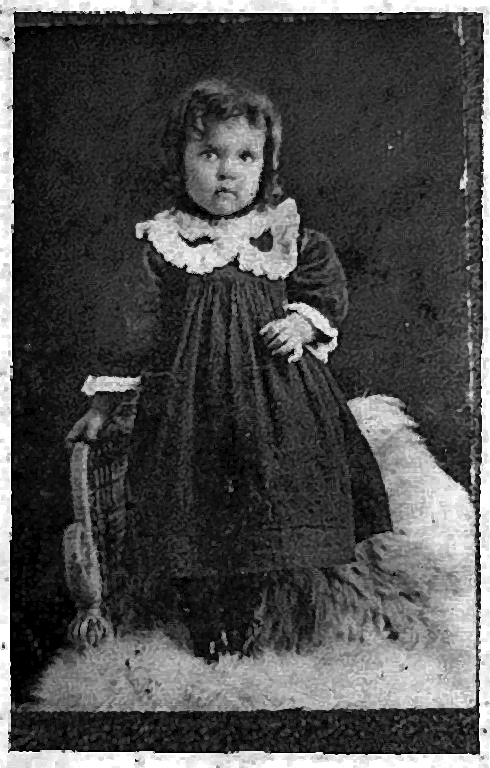
(What can I say? Only that it was ‘once upon a time’; that’s how all the fairy tales begin…)
11 months to the day from when we began ‘full-scale’ usage of WordPress on ManyRoads, we were graced by our 50,000 visitor. 13 November 2010 is truly a landmark day for ManyRoads.
Unfortunately, we do not know the name of our 50,000 visitor; however, we do know that they have visited us some 81 times before. We also know that their Internet Service Provider is located in Redwood, California.
During the past 11 months, we hope you have found our information helpful and even a bit fun. It has been a learning experience for us; one we plan to continue working on down the road. We extend our sincere thanks to each of you who have spent time with us ManyRoads. We hope to see you in the future, again!
Website security & speed are crucial to your genealogy site. Like most websites, genealogy sites are under daily attacked from hackers and information thieves. If you are interested in the latest technology available to speed and secure your site I recommend taking a look at Cloudflare.
ManyRoads has been running the beta version of Cloudflare now for a bit more than two weeks. So far as I am able to determine, our site is operating about 50-100% faster than it was a month ago on HostPapa without the benefit of Cloudflare & Hostgator. The combination of our move to HostGator and Cloudflare seems to have made a significant difference in our site’s performance, and all with few downsides. To date, I have noticed only two short duration glitches in our site availability and one spike in ISP performance.
Looking at ManyRoads statistics, here’s what we see:
9.6 GB bandwidth saved by CloudFlare out of a total of 21.8 GB
164,456 requests saved by CloudFlare out of a total 288,128 requests
Page load time is down to 3.7 from a previous average of 4.53 on HostGator (pre Cloudflare) and 11.1 before on hostpapa without Cloudflare
In fairness, there is one ‘significant’ downside to Cloudflare. Because our site visits are passed to us through Cloudflare’s servers the traditional Visitor plugin I use on ManyRoads no longer can tell me where in the world folks are coming from with certainty. Cloudflare will supposedly provide this information in a later release.Since I first published this post, this problem has been resolved! Hooray!
Briefly here is what the folks at Cloudflare have to say about their product:
CloudFlare protects and accelerates any website online. Once your website is a part of the CloudFlare community, its web traffic is routed through our intelligent global network. We automatically optimize the delivery of your web pages so your visitors get the fastest page load times and best performance. We also block threats and limit abusive bots and crawlers from wasting your bandwidth and server resources. The result: CloudFlare-powered websites see a significant improvement in performance and a decrease in spam and other attacks.
And now as for the best part of the Cloudflare version ManyRoads uses, it is free.
Flucht und Vertreibung Geschichten von Norddeutscher Rundfunk (NDR). German Expulsion histories broadcast and published by North German Radio (NDR).[SinglePic not found]
Even though ManyRoads was completely down due to ISP problems for two days in October, we were still blessed with our highest number of visits ever. Thank you!
In October, we had more than 7300 unique visits. This means, on average, more than 235 folks stopped by for a visit each day.
Based upon our current statistics, our 10 most popular and frequently read pages are:
Please feel comfortable to contact us with any questions regarding our areas of expertise or to request further information/ documentation.
We also greatly appreciate any facebook ‘like’ or retweetsfor page(s) you find helpful, informative or even controversial. Hopefully the Wibiya bar, on the page bottom, is helpful in making that easy.
On planes I often spend time reading ebooks. Generally they are of the less current, more esoteric variety.
Recently I read Siddhartha by Hermann Hesse; the story describes the spiritual journey of a boy from the Indian subcontinent during the time of the Buddha. As I read the tale, I noticed I was not only reading about the journey of Siddhartha but also a story that related to my genealogy efforts.
What follows are quotes from Hermann Hesse’s Siddhartha relating to what I have seen and learned while searching for my family…
I’m telling you what I’ve found. Knowledge can be conveyed, but not wisdom. It can be found, it can be lived, it is possible to be carried by it, miracles can be performed with it, but it cannot be expressed in words and taught.
Oh yes, he too is called upon, he too is of the eternal life. But do we, you and me, know what he is called upon to do, what path to take, what actions to perform, what pain to endure? Not a small one, his pain will be; after all, his heart is proud and hard, people like this have to suffer a lot, err a lot, do much injustice, burden themselves with much sin.
Let the things be illusions or not, after all I would then also be an illusion, and thus they are always like me. This is what makes them so dear and worthy of veneration for me: they are like me. Therefore, I can love them.
To thoroughly understand the world, to explain it, to despise it, may be the thing great thinkers do. But I’m only interested in being able to love the world, not to despise it, not to hate it and me, to be able to look upon it and me and all beings with love and admiration and great respect.
He no longer saw the face of his friend Siddhartha, instead he saw other faces, many, a long sequence, a flowing river of faces, of hundreds, of thousands, which all came and disappeared, and yet all seemed to be there simultaneously, which all constantly changed and renewed themselves, and which were still all Siddhartha.
Social networking is all the rage, even for genealogy. In an effort to try one of the more current if not fully proven tools (it is in a beta phase), I have installed Wibiya.
Wibiya provides a web toolbar that enables blogs and websites to integrate the most exciting services and web applications into their blog or website. Our platform is a one-stop shop for fully customizable, easily manageable third part web applications that can also be tracked for statistics.
The bar may be minimized by clicking on the down arrow at the bottom right. That way if you are like me and use a netbook heavily, the screen real estate can be freed up for content viewing.
Finally, you will note that the toolbar offers several functions which are already on ManyRoads. So, there is really nothing new there. However if the toolbar works well, we will be able to further cleanup and consolidate these social networking functions into a new and more flexible format.
Should genealogy rely on GPS data? When I recently heard the query, it gave me pause especially since people seemed pretty agitated over the point. I have to admit, it does seem that the value of GPS data is a point worth pondering, at least for a little while.
It is probably worth noting that commercial GPS is really only about 10 years old and is primarily a US national system for establishing global location. To quote the ever popular Wikipedia:
GPS is owned and operated by the U.S. Government as a national resource.
Also, there are at least two competing and one non-competing GPS system online or soon to be online:
competing systems will be from the Chinese (Compass) and Europe Galileo (Europe);
the non-competing system is a Russian military system.
As competing & complimentary global positioning systems reconcile and move towards international standards and as new systems evolve, there are likely to be changes in nomenclature and other characteristics. At least that is how everything else seems to work in the technology realm.
Let me conclude with a random thought in this space. If we are looking for an old grave… how does GPS deal with continental drift? Since GPS finds/ identifies a location on the planet presumably this means that in 500 years different things will occupy the old location…. in other words, grampa is on the move ;^) Seriously though at the rate of 1.5 -10 cm movement per year, this could create a grave situation in just a few years (sorry I could not avoid the pun).
To me, the biggest benefit of the current US GPS is that it makes Google Earth and the like usable in genealogy software packages. But to my mind, maps continue to be a more stable and reliable long-term form of locational documentation for genealogical purposes.
Phase one of the ManyRoads transfer to Hostgator.com is now complete. At least, it looks good from my end.
We have moved a lot of files (about 60,000 of the little and huge buggers); not much of this transition has been easy. My daughter and son-in-law have proven immensely helpful in the transition; and my wife has been extremely patient with me throughout the 40+ hour transfer and rebuild process.
By way of a synopsis, here’s what we have accomplished:
All ManyRoads files and software have been moved from Hostpapa to Hostgator.com. If you notice any problems, please let me know via the contact page.
We have optimize the performance of ManyRoads by tweaking the way Apache (our server software) handles requests. We now compress our site content before sending it to your browser. This should lower your bandwidth usage and speed the loading of larger images and files.
We have installed and are using CloudFlare which is a system that acts as a proxy between ManyRoads visitors and our server. By acting as a proxy, CloudFlare caches static content thus lowering the number of requests to our servers.
We have cleaned and optimized the ManyRoads MySQL database; it was quite bloated.
The next phase of our transition will involve yet another move. We plan to move our static content files (libraries,maps, etc.) on to a secondary server in order to better distribute our computing load and also provide redundancy.
Hopefully the worst of our moving is now over. Please let us know how things are working. We especially appreciate your contact should you discover something that slipped through the cracks. Something most likely has….
It saddens me greatly to say that ManyRoads has been down for nearly 20 hours.
As I noted in an earlier message, my previous Internet Service Provider was unable to provide me with informative error messages. As a result, I was unable to tune the ManyRoads site to address its performance difficulties. We simply were consuming too many CPU cycles for a shared server.
Because of our difficulties, I have been forced to change host providers. We are now running on Hostgator. I have also implemented Cloudflare:
CloudFlare protects and accelerates any website online. Once your website is a part of the CloudFlare community, its web traffic is routed through our intelligent global network. We automatically optimize the delivery of your web pages so your visitors get the fastest page load times and best performance. We also block threats and limit abusive bots and crawlers from wasting your bandwidth and server resources. The result: CloudFlare-powered websites see a significant improvement in performance and a decrease in spam and other attacks.
It is my hope that this combination of changes, along with a distribution of our documentation load onto separate host, will lessen our cpu footprint and improve our overall performance.
If you are inclined to help us fund the technology necessary to support ManyRoads we welcome your active participation. Hopefully, the worst is past. If you notice problems please use our contact page to let us know.
We are changing ManyRoads hosting from hostpapa.com to hostgator.com. We have encountered numerous performance issues which seem unresolvable on hostpapa. Hopefully, we will see an improvement on our new web locale.
We hope that downtime is minimal but apologize in advance for any service interruptions.
Over the next month or two, we intend to re-architect ManyRoads in order to both improve response and performance. Again we hope to accomplish this with a minimum of downtime.
If you have specific questions or concerns, please use our contact page to get in touch with us.
What is a traditional genealogical source? To me that seemed to be a good question. So naturally, I Googled the term ‘Traditional genealogical source’ to see what I would find.
The first item I came up with was the topic of a January/February 2003 issue of Ancestry Magazine by Mark Howells:
Tombstone inscriptions have been a source of genealogical information for centuries.
I could see tombstone inscriptions as being considered normal and traditional. Although with the way my brain works, I could also see that tombstones might rapidly be coming passe. As the article itself describes, today’s headstones are nothing like those of yesteryear.
Strangely, to me anyway, the next item I uncovered in Google was the ever popular “Ancestral Tablet”. Now I have a done a bunch of genealogical investigation and yet somehow I had never stumbled upon one of these. According to the article I uncovered:
These tablets were traditionally kept on household altars and in clan temples.
As we say in French “Quelle surprise!” Household altars? Clan temples? Neither household altars nor clan temples were familiar or traditional to me given my forebears and my background. Because of my surprise, I examined the page more closely only to discover the document’s title: Ethnic genealogy: a research guide By Jessie Carney Smith.
Then it occurred to me that traditional was not traditional unless and until you understood and were familiar with the cultural context within which you were conducting your genealogical research. This ‘truism’ applied equally to both examples I found through the courtesy of Google. Although the first finding seemed natural and traditional to me; the second, well, was out of my ‘traditional’ frame of reference. But it certainly was not out of the frame of reference for folks with a traditional Chinese background and familiarity with traditional Chinese cultural norms.
So what is the take away from all of this rambling?
In a global sense, there are very few things that are truly traditional.
Each traditional source is traditional within a particular context: cultural, historical, regional, religious, etc.
You really need to understand where you are seeking and what you might find ‘traditionally’. Just as happened to me, your normal cultural and personal filters could blind you to artifacts that ‘traditionally’ exist for those you seek.
I will explore other traditional sources in subsequent articles. Just in case…
Which Operating system is best? Mac, Linux, Windows?
Well aside from the inaccuracy of the phraseology in the above query, this is a question I often see discussed, debated, and fought with religious fervor. Truth of the matter is quite simple. Use the operating system you like best- for me that means Ubuntu Linux. For you, well, you get to to pick.
However, when making the choice of one operating system over another, people seem to believe they are forced to leave everything about their previous (or simply another) operating system behind. In the genealogy space that often means, a move to Mac or Linx from Windows confounds people as to how to get a good Windows genealogy program functioning on their new found PC home. When these moves occur I hear questions like:
What is the best genealogy software for Mac? I really liked RootsMagic but it doesn’t run on my Mac.
Well the answer is really direct, and only requires a modicum of adventurousness. The simple answer is to set up and run a Virtual Machine on your new PC. Sounds complicated, I know; but, it really is not. In the virtual machine space you have numerous options however, I will focus on my favorite- VirtualBox. To quote their website:
VirtualBox is a powerful x86 and AMD64/Intel64 virtualization product for enterprise as well as home use. Not only is VirtualBox an extremely feature rich, high performance product for enterprise customers, it is also the only professional solution that is freely available as Open Source Software under the terms of the GNU General Public License (GPL). See “About VirtualBox” for an introduction.
Presently, VirtualBox runs on Windows, Linux, Macintosh and OpenSolaris hosts and supports a large number of guest operating systems including but not limited to Windows (NT 4.0, 2000, XP, Server 2003, Vista, Windows 7), DOS/Windows 3.x, Linux (2.4 and 2.6), Solaris and OpenSolaris, and OpenBSD.
What all this means, is you can install a package like VirtualBox on your PC and then install any number of other Operating Systems there as well. The Guest operating systems operate in windows within your main PC environment. There is no need to reboot as you move between environments once ‘all are operational. And for those who do not want to leave an old favorite software application behind, you don’t have to because it will run in the appropriate Virtual machine and it will run in its native mode. Voila! Problem solved.
It is worth sharing an additional data point. In my experience, the pool of essential non-native operating system applications you will need seems to diminish over time. As you adjust to your new environs, you inevitably find new improved ways of doing things. Soon enough your Virtual machine needs shrink to the barest of essentials.
Sometimes we all need help. Everyone falls into that boat at one time or another. As the old Barbara Streisand song says:
“People who need people are the luckiest people in the world…”
(I hope I have that quoted correctly.)
Over the past few months, numerous folks have requested and provided help here on ManyRoads. In order to be responsive, I have organized and published ways in which I am able to help; and sadly, I have also had to state ways in which I am unable to accommodate or have had to limit requested assistance.
Here are some of the approaches and offers I have officially made. Most of these ‘standard’ approaches have grown out of informal arrangements I have been fortunate to establish with generous people discovered through the ManyRoads site and my related genealogical endeavors.
Pay It Forward – for some reason this most obvious of arrangements has taken me the longest to articulate.
Limited free consulting – similar to the Quid pro quo, but limited in time and established without any requirement for formally arranged reciprocation.
Informal – this arrangement does not really fit into any definable category but rather is something that evolves through longer term interpersonal communications. I have numerous relationships that fit into this category; and, they are simply friendships. Some are with new found relatives, some with new found friends. To me, these are extremely joyful arrangements.
So why the discourse, then? Well, I think it is essential that people who meet others doing genealogy on the web via social media, etc. recognize and acknowledge that all involved parties are people with needs, constraints and limitations. Each party whether engaging through a formal or informal arrangement has the duty to express their wishes, aspirations and ‘needs’. Sometimes these associations and relationships work out and become long term; sometimes not. No matter the result, I think there are some ‘common’ courtesies (?) worthy of mention:
Prompt acknowledgement of any communication. Let the other person know what you are thinking. Talk personally, privately and promptly.
Publicly or privately recognize any effort taken in your behalf. A simple thank, you will often suffice.
Be aware no matter how small the effort, it is being made on your behalf. The effort is a gift and deserves to be appropriately acknowledged.
Well it’s about time for the ManyRoads Monthly Update-Newsletter. The past month has been quite eventful.
Among the most interesting events to occur during the past month is that our visitor numbers have grown moved from around 130 per day to nearly 200 per day. I understand that for large sites, we are still pikers. However in the genealogical world, according to Genealogy.org, we are in the top 35 of the sites tracked by them.
As our readership continues growing, we are also being allowed to discuss our genealogy interests in other venues. In terms of Guest Blogging, I am no longer just a guest Blogger on http://geneabloggers.com but have also been invited to write for http://obituarieshelp.org.
Before I open this month’s laundry list of happenings, I want to request any/all of you who have genealogical websites consider reciprocal linking with ManyRoads. There is no cost and both your site and ManyRoads will benefit from the links. Simply place a link to http://many-roads.com on your site; send me an email letting me know you have made the link; and, I’ll place a link to your site.
Finally the list! Here are other ManyRoads items of note from the past month:
We have gone public and become official with our Pay it forward arrangements. Please contact us if you have information to share. To the extent possible, we make everything we receive free to our readership. The only impediment we have experienced thus far that precludes providing free access is copyright.
I am pleased to inform everyone that the presentation on 9 October 2010 went quite well. We had 15 folks in attendance. As always, the discussions were lively and interesting.
You may notice from the photo, we are a very young and energetic bunch! Oh, and I am getting thinner every day – I mean hair-wise, of course.
A copy of the presentation is available for free download:
Thursday the 7 October 2010 was one of those spectacular days for a family genealogist!
I went to the Parker Family History Center to do research in the Ladekopp/ Pietzkendorf Evangelische Kirche records. I had no idea what, if anything I might find. What I found was both amazing and joyful. I found my grandmother’s baptismal record (birth record):
Frieda Auguste Recht
I also found the records for two of her siblings, Ella and Ernst.
Ella Selma Recht
Ernst Hermann Ferdinand Recht
Based on the information I uncovered here is what I believe to be the situation.
The Hermann Recht- Auguste Kunz family moved to Pietzkendorf, near Ladekopp, after the birth of their eldest daughter Erna in November of 1892 but before the birth of their son Ernst in December of 1893. I also discovered that a Ferdinand Kunz of Neuteicherwaelde was in attendance at the baptism of Ella Recht in December of 1896. My thoughts are that this might be either the father or brother of Auguste Kunz. The search continues!
By the end of WW2, the destruction of Germany was nearly total. Almost every city had been leveled; the remnants of families were scattered all over Germany, Europe, North and South America. Everyone had lost family members or friends. According to Wikipedia losses in the Third Reich were:
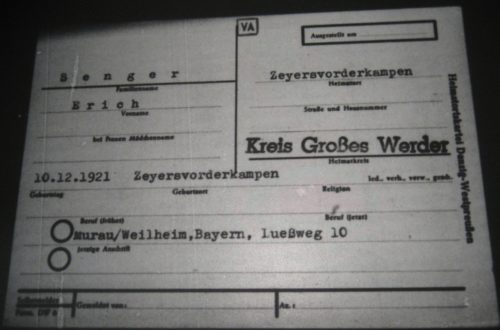
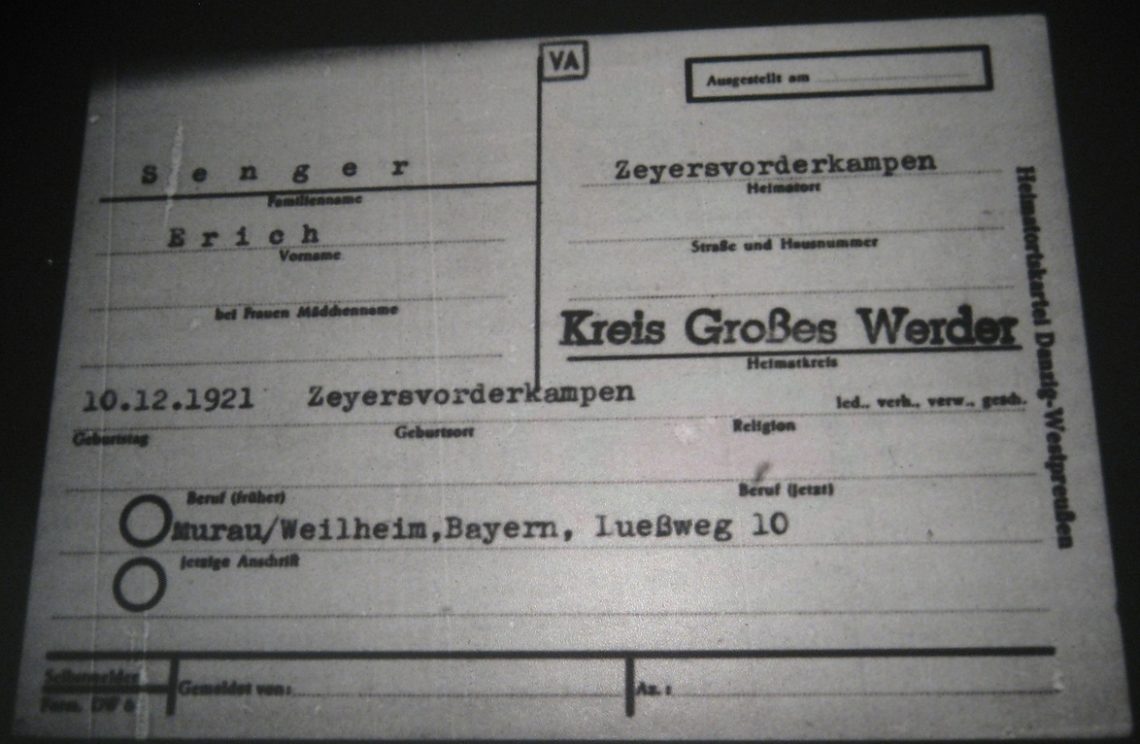
A Heimatsortskartei was set up in post WW2 Germany for the purpose of identifying and locating people in the catastrophic aftermath and destruction of WW2. Finding loved ones and discovering their fate was essential.
The Heimatortskartei provided hope and was the resource. Although these files may not be readily accessible in Germany because of the infamous Datenschutz -data protection laws; they are available through the LDS Church Archives.
And now a personal history of the Heimatortskartei use…
Date: 1998/05/30 20:16:45
From: W. Fred Rump [email address removed]
Hi,
Many months ago I promised Wolfgang N[...] a report on what is to be found in these films [Heimatortskartei]. Below is a sample of the contents of the film available at the LDS for two particular houses in Elbing, West Prussia as of January 1945.
The following residents were found in a film obtained from the FHC in Salt Lake City entitled: Heimatsortskartei Danzig-Westpreussen. It particularly references certain streets in Elbing, Westpreussen among which is the one I was born on, namely Tannenberger Allee. Some background and recollections are included in this report which I just wrote while traveling across the US.
In my visit to Elbing in 1995 I found #97 still standing and in need of some maintenance like most other houses in the area. The old red brick which I still remember was now gone and again, like most other houses, was now stuccoed which patchy gray cement. I don’t have too many memories of my childhood or Elbing. This is rather strange to me since I lived there from my birth in December 1937 until our sudden exit in January 1945. By then I was eight years old and should really have very vivid recollections of earlier times. What exists is not fluid but rather come in bits and pieces mostly of times when I got into some kind of trouble. Other memories are confused as to whether they are from stories told by my mother, other relatives or from pictures I’ve seen. It bothers me greatly that I don’t have better recollections of my pre-1945 childhood. Time seems to have started with our flight from the Russians and everything before that is very blurred and fragmented. I suppose what I know is a mixture of things. I will never know what is real from my experiences and what came to me from other sources later in life. In any case, my youth and size influence the pictures I have formed at the time. Things simply used to be much bigger and more impressive from what I saw in 1995.
I remember the front steps. I sat on them quite often and the individual steps were much higher. I had to climb up three individual steps to get into the house. Today these same steps went down. They were also very normal in size. The street had been raised as the rubble of the destruction of the city was simply used to elevate many streets of the city and then resurfaced by the new occupants of the city after the war. The big chestnut trees were also gone and smaller trees now stood in different locations. Those chestnuts provided much fun as my sister and I created little figures out of them by joining various sizes with little sticks and carving eyes into them.
The other major change to my view of the street was the missing house next door (#95) where my Aunt and Uncle, Erna and Fritz Gro[ss] lived among other residents. Their children, Waltraut (Traute)+ and Erwin, today live in Eschweiler near Aachen. I suppose that house was bombed or burned and never restored. We lived right across from a railroad freight yard and I expect that quite a bit of fighting was going on there along with bombing of the railroad. There used to be a path, the width of a small driveway, which permitted access to the rear of both properties. It was in back of #95 where our huge garden was located. How small it had gotten.
The garden is where the Stachelbeeren (gooseberries) grew. There were fruit trees back there and many delicious items could be retrieved in the summertime. I had always dreamed of this vast garden of my childhood and here in 1995 it was but a small patch of nothingness. It is possible that a couple trees still standing dated to pre-1945 but they looked nothing like the large trees of delicious magic which I thought had stood there. The garden was a big, big disappointment to me. What did they do to my garden?
Turning to the rear of #97 there was another set of steps there. This time they still went up just as I remember them. My grandfather’s work shed was still there too but it used to be so neat and always seemed to be freshly painted. There was no evidence of any paint ever having touched it left. Back to the front of the house I look up to what used to reach to the sky. Three stories of windows had shrunk to just a normal house. An old lady with one gold tooth looks out the bottom floor window and smiles. What a view!
It is difficult talking to her but I suppose she knew why we were there. Most people know that the Germans who come to visit used to call this home. The current residents are almost embarrassed at the set of circumstances but are friendly and open to the situation. We get a drift of complaints from our one- tooth lady. Nothing is ever fixed in the house. It belongs to the city now. We try to get away from her as communications is not going well. I walk down the front steps into what is the Treppengang (stair entrance to the various apartments).The tiled floor is still the same. That seems odd to me. I rush up the steps just to see if the door to our place is where I thought it was. It’s still the same. I try to take a picture but the camera does not want to flash in the dark and I’m too nervous to fix the problem. I have to leave and go away.
I shoot some outside pictures and promise myself to reconnoiter the railroad on the other side. That’s where the near empty drum of tar used to be were I just had to climb in to see what was there. One of those eventful happenings a boy tends to never forget. Of course there are many other recollections mostly of the ‘getting into trouble’ kind but these will be written up in a section of my growing up.
My mother inherited both properties from her father upon his death. My parents paid the other children their appropriate shares as my grandfather had wanted. My parents were deeply hurt when after the war some of my mom’s sisters had casually forgotten these payoffs and now claimed equal shares of the little money my parents received from the German government under the term: Lastenausgleich. The idea was to provide a small amount to start anew and also to relinquish what was now in Polish hands. Luckily the legal papers were found and the entire matter was cleared up but the hurt remained. I had often wondered as to who all the people were who lived in our houses. My parents often spoke of such and such and I never paid too much attention then.
From a friend I met on the internet (Wolfgang N[...]) I found out that the LDS has films of the Heimatortskartei which were collected by the various refugee groups in order to find lost relatives. I ordered these films back in November of 1997 and did not get to see them until May of 1998. I do not know if the list includes everyone or is just a listing of those who had an inquiry posted about someone.
In any case, for the sake of history here are the listed residents of #95 and #97 Tannenberger Allee. We start with what was found in house number sequence for #95:
Ausgestellt (submitted) 3.4.53, (by) Erna Gross, nee Robiller; born 4.3.04 in Elbing, nach (went to) Finow/Mark (Brandenburg), Kastanienallee 23; dann (then) Emden, Auricher Strasse 23, dann Eschweiler/Kr Aachen, Kreichsburg 16. Sucht (is looking for) Gross, Fritz, 24.3.05, Elbing, Maschinenschlosser bei Schichau. +31.12.45 ?
Ausgestellt 1.6.56, Erwin Gross, 9.11.31 Elbing, dann Ludwigshafen-Friedenheim, Hindenburg Str 2, Suchdienst fuer Fritz Gross am 19.3.45 von Polen verschleppt.
I want to express my heartfelt gratitude to our readership. During the month of Septemeber, we experienced our largest readership ever, nearly 6500 of you stopped by for a bit. More precisely, 6497 of you visited. Never before had we crested 5000 vistors in one month, let alone 6000.
We hope you will continue to find our information useful. Please let us know if we can be of additional help as well. Remember, we happily offer a free consulting session and answer emails, comments, and queries as quickly as time permits.
Also, we encourage you to sign our Guest Book or simply drop us an email.
This page is under development; research is on-going
Note: additional source materials are currently being obtained.
The Otto und Ella Wedhorn history is unusually sad one. It is also one of resilience. Otto and Ella were Luise Senger’s Aunt and Uncle (Ella was sister to Frieda Recht). Our families had basically been lost to each other until 2011 when Norbert Grohmann contacted me here on ManyRoads.
Otto Wedhorn was born on October 17, 1878, location under investigation.
Ella Recht was born in Pietzkendorf, West Prussia on born: 21 Dec. 1896 – baptized: 21 Feb. 1897
The Wedhorn’s and their family, like the Senger’s, were severely impacted by World War 2; many did not survive. Here is what we know:
Otto Wedhorn Senior was fortunate and survived the conflagration. Otto and the surviving members of the Wedhorn Family, with the exception of Frieda, lived in the German Democratic Republic (DDR- Deutsche Demokratische Republik; the Soviet Zone of Germany). In 1963, Otto Wedhorn (Sr.) died in a hospital near Fichtenwalde, a few days after having a stroke (Gehirnschlag). He was 84 years old. His daughter Kaethe was with him up to his end; but his daughter Frieda, could not visit him any more after the Berlin Wall was built in 1961.
Ella Recht was raped by invading Soviet troops in her home in Orlofferfelde. In that same time period, Ella Recht’s deportation to the Russian Gulags was not undertaken because she had contracted typhus. The Russians let her go due to the risk of spreading infection. Ella died in a hospital in Elbing on May 18, 1945. It was her silver wedding day.
Like so many German women, Frieda geb. Wedhorn was deported into a forced (slave) labor camp (Gulag) in the USSR in 1945. Frieda managed to survive the ordeal and in 1947 was finally released to a reception camp in Frankfurt/Oder.
Otto Wedhorn and Ella Recht were married in Ladekopp, West Prussia. The date of their marriage was May 18, 1920. Their marriage was unhappy and produced four known, named children:
Otto (According to Frieda geboren Wedhorn: In 1945, Otto Wedhorn, Jr. was together with his mother Ella in an assembly camp where the Germans to be deported were rounded up; but due to [a] typhus breakout in that camp, the Russians didn’t want Otto even though he was not infected and so they told them to go away. Otto Wedhorn (Jr.) when relating his Vertreibung ordeals to Frieda mentioned that the Soviets acted as if they were almost afraid of him, a 15 year old boy. In truth it was probably because he came from the typhus infected assembly point where Ella Recht died. Later after the Soviets discontinued their initial deportation program of German civilians, they even gave him bread to eat and treated him almost nicely. But Otto Jr. had to be very careful with the Poles who were rather aggressive when they discovered he was German. Otto Wedhorn (Jr.) remained in Elbing until he had buried his mother Ella, and then he went home to find his father and sister.)
Research is underway in the ev. Kirche Ladekopp to determine what, if anything, can be found. This history is based upon a verbal history from Luise Senger Rabideau as told to Mark Rabideau. As noted above, on 6 October I was contacted by Norbert Grohmann, Frieda Wedhorn’s son. He, his sister Monika and I have been actively sharing stories with an eye towards more accurately describing what happened to the family during and after WW2. Below are the photos I have of the family from Norbert & Monika Grohmann.