Senger Family Lands & Possesions
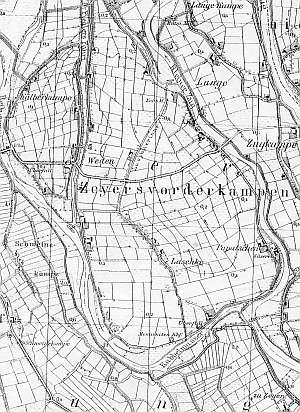
The Senger family were neither rich nor famous. They were hard working German farmers who tilled the soil and built the land (much like their forebears before them did in Holland). Richard Senger, at the outset of World War 2, was also an owner of the Kaeserei in Zeyervorderkampen (I do not know if he had other co-owners, perhaps one of our readers can help clear that up).
Below you will find images of the location of the Richard Senger family farm and business.
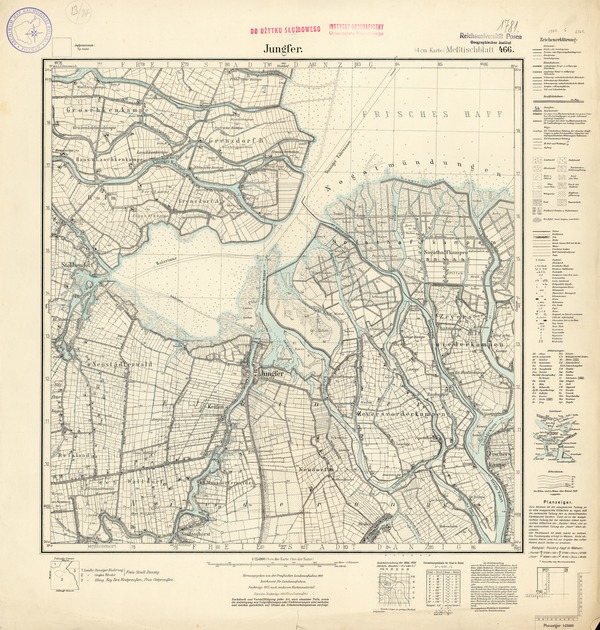
Old Map of Senger Farm and Kaeserei
Further Readings
Old Senger Farm in 2010 (now the Bednarczyk Farm)
Former Senger Farm in 1978 Visit by Erich Senger
I have had the wonderful good fortune of being introduced to the current owners of the former Senger farm- the Bednarczyks. The Bednarczyk’s love their land and farm as much as my family did in days gone by. They are doing a wonderful job of managing and caring for the farm and lands. I am happy to share the history of the house, farm, and people who preceded them.
Together, we can walk into the future with friendship and a shared history…
Polish translation provided by Google Translate:
Miałem wspaniałe szczęście wprowadzeniem do obecnych właścicieli byłych Senger gospodarstwa Bednarczyks. Bednarczyk miłość ich gruntami i gospodarstwem jak moja rodzina nie w przeszłości. Oni robią wspaniałą pracę w zakresie zarządzania i dbałości o gospodarstwo i ziemie. Cieszę się akcja historii domu, gospodarstwa rolnego, oraz osób, które je poprzedzały.
Razem możemy iść w przyszłość z przyjaźni i wspólnej historii …
Related Readings:
Note: There is related material in the following category/ categories: Our Families | Senger
Alternatively, the following related selections (up to 10 most recent related posts) are provided for you automagically»»


Contact Us!
Hi,
I found the way to your website via the forum.dazig.de.
Congratulations, I’m very impressed about what you are carrying together about the Elbing – Zeyer region.
Due to the Zeyer church books starting in 1773 (westpreussen.de) I had assumed that Zeyer is a relatively new village and the whole area was under water until the 18th century. Last year I met in Zoppot a Polish professor (living in the house, where my cousins used to live in the thirtees) who showed me a map designed in 1907 / 1922 about the Weichsel – Nogat mouth in 1300. And to my surprise I found there Zeyer on a narrow east-west landbridge. Therefore, did you find out, where in Elbing were held the church books fort he Zeyer region before 1773? Do you have other information / literature recommendations about the Zeyer region, its history and especially about the development of the Kampen?
If you are interested I can mail the map.
One of my ancestors – he is listed in my aunt’s Ahnenpass and in the Landaufnahme from 1772 – http://www.odessa3.org/collections/land/wprussia/ – was presumably the owner of the Grosse Jacob Glodde Buddenkampe = Grosse Buddenkampe = Glodsche Kampe, very close northeast from the Senger farm and Kaeserei in Papatschen / Nogatz. If the Sengers used to live there at the end of the eighteenth century then our ancestors must have known another.
Do you search in your microfiches also for other people? If yes I would provide more details.
Beautiful Colorado: I passed it hitchhiking in the year when Nixon resigned … already some time ago …
Best regards from Dakar, Senegal,
Rainer Mueller-Glodde
Hello Rainer
I have just ordered pre-1773 ev. Kirche Taufen, Heiraten usw Buecher for Sankt Annen und Heilige Leichnamm in Elbing. They held the documents for Zeyer before 1773. And yes, my relatives were there for some time before 1773 (how long I am not certain). My mother believes they may have arrived during the Dutch migration in the 1300- 1400s. I don’t know.
When I am doing research in the Zeyer books I can certainly try to check for people etc. Just email me with the names you’d like researched and some pointers as to dates. I can then give you a better reply.
Was tutst du in Senegal????
Gruss
…mark
Hi, Mark,
Thanks for your fast answer and your offer.
To start with your final question: We – my wife Petra and I – are both working in the so-called International Technical Cooperation, comparable with your US-AID. Petra long-term, I as a freelancer. We have been living and working in Latin America, Asia and presently we are in Dakar. Our son just finished the International America School and is now heading for the Richmond College, VA.
If you want to know what is going on between Dakar and Timbuktu see
http://mueglo.net/Timbuktu/index.htm
Username: Timbuktu
Password: dakar08
Due to my message from yesterday I returned today to what I have about the Nogat mouth finding a certain surprise. Two years ago a Dr. Glodde from Berlin, who tried to find out the meaning of “Glodde”, sent me a shot he made of a document from about 1805 in the Geheimes Staatsarchiv Preussischer Kulturbesitz. The subject is the estimation of the size of the Grosse Jacob Glode Buden Kampe. It contains the following sentence:
Explication
Zum Plan von der Großen Buden Kampe
Kott Kampe und Lange Hacken, Sämtliches Land
gehörte ehmals dem Einsaßen Glodde, wovon derselbe
an die Sengers und Barwigs die Kott Kampe und Lange Hacken verkaufte welche damals betrugen 8 Huf : 12 m : Cut
welsches aus der unten stehenden alten Berechnung auch zugleich aus
der neuen Vermeßung Berechnung zu ersehen ist wie viel die außen Kampen sich vergrößert haben
You see, our ancestors met another. If you want a copy send an address.
Small correction: there was the Grosse Jacob Glodde Buden Kampe, later – after Jacob had sold it – called Grosse Buden Kampe and east of it, how maps from 1865 and 1931 show, the “Glod’sche Kampe”
The details concerning my Glodde ancestors:
- Jacob Glodde, born presumably between 1740 and 1760, apparently the (first???) ownwer of above mentioned Kampe. In the Marburger Auszüge from 1772 -http://www.odessa3.org/collections/land/wprussia/ – he is listed as Jacob Glodder (with an additional r). In general, the name appears in different variations: Glodd, Glod, Glodt, etc.
- His wife: Christina Baarzichin (I’m not quite sure about the correct spelling)
- His son: Barthel (Bartholomäus) Glod(de), born on 19.10.1778 in Zeyer-Kampen (I never found that location. Presumably the priest shortened it and it is meant Zeyers Niederkampen).
He moved to Steegnerwerder (close to Steegen) and died there on 12.04.1850
- His son’s wife: Anna Christina Gerthß (Goertz), born 23.09.1178 in Fischerbabke, died on 12.02.1851 in Steegnerwerder
If you find any Glodde, Glod etc. in the Zeyer churchbooks also in the nineteenth century and in the Elbing churchbooks before 1773 I would be very interested in them.
My father researched the family history in the Werder as a youth between 1930 and 1933 (before the Nazis) and came until the 30 year war (1618 – 1648), saying that at that time one part of the family came from the Netherlands (Wasserbauern). I’m not sure, but it appears that a part of the Kampen in the Nogat mouth was constructed in the 18th century. Therefore to go back until 1300 will be difficult.
Today I got the book Hugo Bertram, Wolfgang La Baume, Otto Klöppel: Das Weichsel-Nogat-Delta, Münster 2003, a reprint from the 1924 edition. It contains the map of the Delta from 1300 I mentioned yesterday. The content I do not know yet … that will take time.
Presently I plan to go to Danzig and the Zeyer region in September / October.
Best regards, Rainer