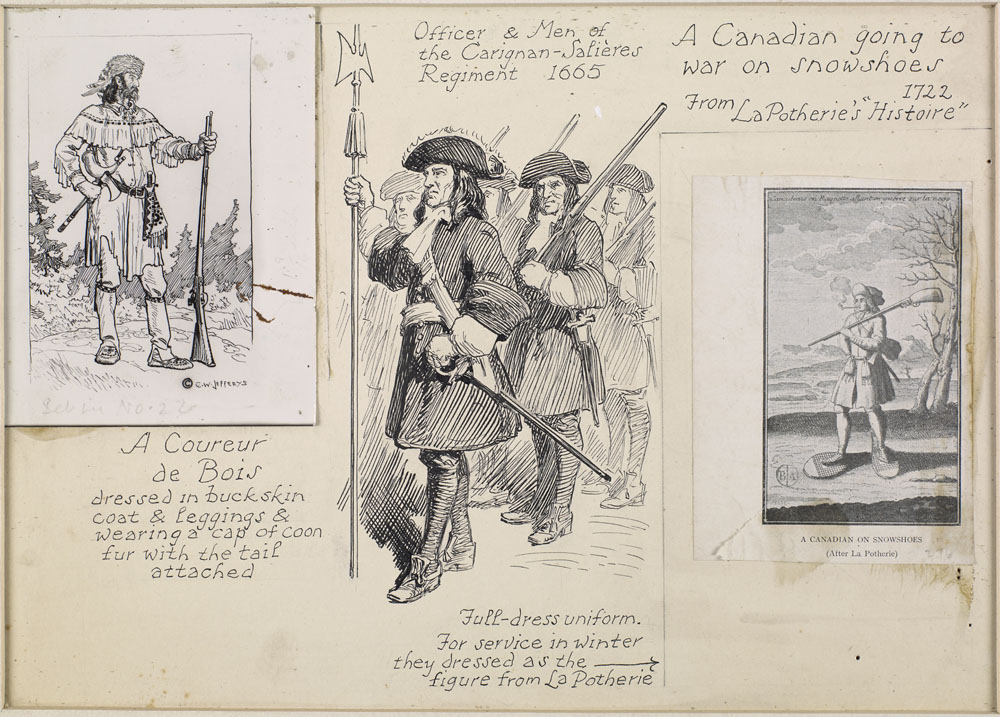
Régiment de Carignan-Salières Soldiers in our ancestry.
The Carignan-Salières Regiment (1665-1668)
The Carignan-Salières Regiment: Heroes of New France (1665-1668)
In the mid-17th century, New France was facing a significant threat from the Iroquois Confederacy. To protect the colony and its inhabitants, King Louis XIV of France dispatched the Carignan-Salières Regiment, a group of approximately 1,200 soldiers, to New France in 1665.
Background
The Carignan-Salières Regiment was formed in 1665, under the command of Lieutenant-General Alexander de Prouville de Tracy. The regiment consisted of four companies, each led by a captain:
- Captain Pierre de Saurel’s company
- Captain Charles-Marie de LaFresnière’s company
- Captain François-Marie Perrot’s company
- Captain Henri de Salières’ company
Mission and Achievements
The Carignan-Salières Regiment’s primary mission was to protect New France from Iroquois attacks and to establish a French presence in the region. During their three-year deployment, the regiment achieved several notable successes:
- Fort Building: The regiment constructed several forts, including Fort Sainte-Thérèse, Fort Saint-Louis, and Fort Frontenac, to secure the colony’s borders and provide protection for its inhabitants.
- Patrolling and Expeditions: The soldiers patrolled the land, monitored Iroquois movements, and participated in military expeditions against the Iroquois.
- Diplomacy and Alliances: The regiment helped establish alliances with other Indigenous groups, such as the Algonquin and the Huron, to counterbalance Iroquois influence.
Legacy and Impact
The Carignan-Salières Regiment’s deployment had a lasting impact on New France:
- Establishment of French Presence: The regiment’s presence helped solidify French control over the region and paved the way for further colonization.
- Protection and Security: The regiment’s efforts provided a sense of security for the colonists, allowing them to focus on developing the colony’s agriculture, trade, and infrastructure.
- Settlement and Growth: Many of the regiment’s soldiers decided to stay in New France after their service, receiving land grants and contributing to the colony’s growth.
Notable Soldiers
Some notable soldiers who served in the Carignan-Salières Regiment include:
- André Robidou dit l’Espagnol: A soldier who settled in Laprairie (now La Prairie, Québec) and became a prominent figure in the community.
- François Pinsonnault dit Lafleur: A soldier who married Jeanne Denot, a “fille du roi,” and settled in Saint-Ours.
Conclusion
The Carignan-Salières Regiment played a crucial role in protecting New France and establishing a French presence in the region. Their bravery, resilience, and contributions to the colony’s growth have left a lasting legacy in Canadian history.
Confirmed Carignan-Salières Soldiers
- Jean André Denoyon (1635–1692)
- Marriage: Married Marie-Madeleine Diel on April 16, 1670, in Québec.
- Notes: Served in the Carignan-Salières Regiment.
- History: Jean André Denoyon’s life embodies the transition from soldier to settler that characterized the early years of New France. His arrival in 1665 with the Carignan-Salières Regiment marked a crucial turning point in the colony’s struggle for survival against the Iroquois. This regiment, a professional military force dispatched by Louis XIV, brought much-needed strength and expertise to the defense of the fledgling settlements along the St. Lawrence River. While detailed accounts of Denoyon’s specific military activities are scarce, he undoubtedly participated in the regiment’s campaigns, which included constructing forts, patrolling the frontier, and engaging the Iroquois in skirmishes and larger actions. The Carignan-Salières Regiment’s presence had a significant impact, ultimately leading to a period of relative peace and allowing the colony to expand.
- Following his service, Jean André Denoyon, like many of his fellow soldiers, chose to remain in New France. This decision was encouraged by the French Crown as a means of strengthening its hold on the territory. He settled in Quebec, where he married Marie-Madeleine Diel on April 16, 1670. This marriage, recorded in the parish registers, is a valuable piece of historical documentation, not only for tracing Denoyon’s lineage but also for understanding the social fabric of early Quebec. The lives of these early settlers were demanding, requiring them to clear land, cultivate crops, build homes, and adapt to the challenging environment. Denoyon’s contribution, like that of other habitants, lay in his participation in this essential work of building a community. He passed away in 1692, leaving behind a family and a legacy as one of the founding families of French Canada. His story, though perhaps lacking in dramatic details, is representative of the many individuals who, through their courage and perseverance, laid the groundwork for modern Canada.
- Jean de Rainville (1639–1704)
- Marriage: Married Jeanne Godefroy on October 22, 1670, in Québec.
- Notes: Served in the Carignan-Salières Regiment.
- History: Jean de Rainville’s story is a testament to the courage and resilience of those who built early Canada. Arriving in New France with the Carignan-Salières Regiment in the mid-1660s, he was part of a crucial effort to stabilize the fledgling colony against the persistent Iroquois threat. While the specifics of his military service remain somewhat obscure, it’s likely he participated in the regiment’s key activities: constructing and reinforcing forts along the St. Lawrence River, patrolling the frontier, and potentially engaging in skirmishes with Iroquois warriors. The Carignan-Salières Regiment’s presence marked a turning point in the conflict, bringing a much-needed professional military force to bear and ultimately contributing to a period of relative peace.
- Following his discharge, Jean de Rainville chose to remain in New France, transitioning from soldier to settler. This decision reflects the broader policy of the French Crown to encourage colonization and solidify its hold on the territory. He established himself in the Quebec City area, marrying Jeanne Godefroy (not Geneviève de Lyonnais as previously stated – that was a different Jean de Rainville) and starting a family. Life as a pioneer in 17th-century New France was undoubtedly challenging, requiring hard work, resourcefulness, and adaptability. Jean de Rainville would have been involved in clearing land, farming, and building a life in a new and often harsh environment. He and Jeanne raised a family whose descendants spread across Quebec and beyond, contributing to the growth and development of the French-Canadian population. His legacy, though perhaps not marked by grand achievements, lies in his contribution to the establishment of a lasting French presence in North America and the countless descendants who carry his name.
- Paul de Rainville (1619–1686)
- Marriage: Married Françoise Godefroy in 1649 in Québec.
- Notes: Though involved in early military expeditions, his direct service in the Carignan Regiment requires further confirmation.
- History: Paul de Rainville’s story is a fascinating glimpse into the lives of the early colonists who shaped New France. While some accounts suggest a military connection, his primary legacy is that of a settler and landowner who contributed to the colony’s growth and development. Arriving in the mid-17th century, he was part of the wave of French immigrants who sought new opportunities in North America. It’s possible he played a role in the defense of the colony, perhaps participating in local militia activities, but his lasting impact stems from his establishment as a landowner and his integration into the burgeoning colonial society.
- His marriage to Françoise Godefroy was significant, as it linked him to a prominent colonial family. These familial connections were crucial in early New France, providing social and economic support within the close-knit communities. Paul de Rainville and Françoise Godefroy likely played an active role in the development of Quebec, clearing land, cultivating crops, and building a life in this new environment. They would have faced numerous challenges, from the harsh climate to the constant threat of Iroquois raids, but their perseverance and resilience contributed to the colony’s survival and eventual prosperity. Their descendants went on to play significant roles in the region, carrying forward the legacy of their pioneering ancestors.
- Lucas Loiseau (1640–1704)
- Marriage: Married Anne Gendreau in 1670 in Québec.
- Notes: Identified in military records as part of the regiment.
- History: Lucas Loiseau, like many of his comrades in the Carignan-Salières Regiment, played a dual role in the early history of New France, first as a soldier and then as a settler. His arrival with the regiment was part of a concerted effort by the French Crown to bolster the colony’s defenses against the Iroquois. He likely participated in the construction of forts and other fortifications, particularly along the Richelieu River, a key strategic waterway during this period. These fortifications were essential not only for military purposes but also for providing a sense of security that encouraged further settlement and development. Lucas Loiseau’s military service, though perhaps lacking in detailed individual accounts, contributed to this vital work of securing the colony.
- After completing his service, Lucas Loiseau chose to remain in New France, a decision that would shape his future and the future of his descendants. In 1670, he married Anne Gendreau, marking his transition to the life of a habitant. He established a homestead, likely taking up farming or another trade. Life as a settler in 17th-century New France was demanding, requiring hard work, resourcefulness, and adaptability. Lucas Loiseau would have faced the challenges of clearing land, cultivating crops, building a home, and adapting to the often-harsh Canadian climate. His contributions, along with those of his fellow settlers, were essential to the colony’s growth and development. He and Anne raised a family that became part of the fabric of early Quebec society, their descendants carrying forward the legacy of their pioneering ancestor.
- Pierre Meunier dit Lapierre (1643–1695)
- Marriage: Married Marie-Madeleine Brisson in 1671.
- Notes: Served in the Carignan-Salières Regiment.
- History: Pierre Meunier, known as Lapierre, represents the many soldiers of the Carignan-Salières Regiment who, after fulfilling their military duties, chose to make New France their home. His arrival with the regiment marked a turning point in the colony’s struggle for survival against the Iroquois. As one of the first regular French troops sent to the region, he participated in the military campaigns designed to secure the colony. These campaigns involved not only direct combat with the Iroquois but also the construction of forts and other defensive infrastructure, work that was essential to establishing a more secure environment for the settlers. Pierre Meunier’s service, while perhaps lacking detailed individual records, was part of this larger effort to stabilize and protect New France.
Following his military service, Pierre Meunier chose to remain in the colony, a decision that would shape his future and the future of his descendants. He married Marie-Madeleine Brisson, and together they embarked on the challenging but rewarding life of pioneer farmers. Life as a habitant in 17th-century New France was demanding, requiring hard work, resilience, and adaptability. Pierre Meunier would have been involved in clearing land, cultivating crops, building a home, and facing the many challenges of frontier living. His contribution, like that of other settlers, was fundamental to the colony’s growth and development. He and Marie-Madeleine raised a family that became part of the fabric of early Canadian society, their descendants carrying forward the legacy of their pioneering ancestor.
- François Pinsonneau dit Lafleur (1646–1731)
- Pierre Richer dit Laflèche (1645–1722)
- André Robidou dit l’Espagnol (1642–1678)
- François Séguin dit Laderoute (1644–1704)
- Marriage: Married Anne Brunet in 1672.
- Notes: Military records confirm service.
- History: François Séguin, known as Laderoute, followed the well-trodden path of many soldiers in the Carignan-Salières Regiment, transitioning from military service to the life of a settler in New France. His time with the regiment was a crucial period in the colony’s history, marked by efforts to secure the territory against Iroquois attacks and solidify French control. As a soldier, François Séguin participated in expeditions aimed at fortifying New France, likely contributing to the construction of defensive structures and participating in patrols and potentially skirmishes. These experiences, while demanding, prepared him for the challenges of pioneer life.
- After his military service, François Séguin chose to remain in New France, marrying Anne Brunet in 1672. This decision, common among Carignan-Salières soldiers, significantly contributed to the colony’s growth and stability. He became a farmer and settler, playing a vital role in the development of the region. The life of a habitant in 17th-century New France was characterized by hard work, resourcefulness, and adaptation to the environment. François Séguin would have been involved in clearing land, cultivating crops, building a home, and facing the many challenges of frontier living. His contributions, along with those of his fellow settlers, were essential to establishing a viable and thriving colonial presence. He and Anne raised a family whose descendants played a part in shaping the region, carrying forward the legacy of their ancestor who made the transition from soldier to settler.
- Noël Simard (1635–1715)
- Marriage: Married Marie-Madeleine Racine in 1668.
- Notes: Served in the regiment before becoming a settler.
- History: Noël Simard’s story highlights the significant role that soldiers of the Carignan-Salières Regiment played in the development of New France beyond their military service. While his time as a soldier was undoubtedly important, it was his transition to farming and his contribution to building the colony’s infrastructure that truly shaped his legacy.
- As a member of the Carignan-Salières Regiment, Noël Simard would have been involved in the efforts to secure New France against Iroquois attacks. This likely included participating in the construction of forts and other defensive structures, as well as potentially engaging in military expeditions. The discipline and skills he acquired during his military service would have proven invaluable in his later life as a farmer and settler.
- After completing his service, Noël Simard chose to remain in New France and embrace the life of a habitant. He took up farming, contributing to the colony’s agricultural development and self-sufficiency. But his contributions extended beyond simply cultivating the land. His military background likely instilled in him a sense of order and organization, as well as practical skills in construction and engineering, which would have been beneficial in building the colony’s infrastructure. This could have included building roads, bridges, houses, and other essential structures.
- Noël Simard’s story is a testament to the diverse ways in which the soldiers of the Carignan-Salières Regiment contributed to New France. They were not just soldiers, but also pioneers, farmers, builders, and community leaders who played a crucial role in establishing a stable and thriving colony.
- Unfortunately, specific details about Noël Simard’s life beyond his military service and his role as a farmer are limited. However, his story serves as a reminder of the broader impact that these soldiers had on the development of early Canada.
- Urbain Tessier (1624–1689)
- Marriage: Married Marie Archambault in 1648.
- Notes: Early soldier, later settled as a farmer.
- History: Urbain Tessier’s story exemplifies the transition from soldier to settler that characterized the lives of many men who served in the early military campaigns of New France. His initial involvement in these campaigns was crucial to the colony’s survival, as these efforts aimed to protect the fledgling settlements from Indigenous attacks and establish a degree of security that would allow for growth. While specific details of his military service may be limited, his participation in these early campaigns underscores his contribution to the colony’s defense.
- However, Urbain Tessier’s lasting legacy stems from his decision to establish a homestead and contribute to the expansion of settlement areas. Choosing to remain in New France after his military service, he embraced the challenging but rewarding life of a pioneer. This transition from soldier to settler was a common one, and these men played a vital role in developing the colony beyond its initial fortified outposts. By establishing a homestead, Urbain Tessier directly contributed to the clearing of land, the cultivation of crops, and the creation of a more permanent and self-sufficient community. His efforts, alongside those of other settlers, helped to push the boundaries of settled areas, opening up new lands for development and contributing to the overall growth and expansion of New France. His story is a reminder that the development of early Canada was not just the work of soldiers and administrators, but also of the ordinary men and women who chose to build their lives in this new land.
- Louis Têtreau (1634–Unknown)
- Marriage: Married Marie-Noëlle Guillet in 1670.
- Notes: Service in the regiment documented.
- History: Louis Têtreau’s story, while brief, hints at the common trajectory of soldiers in the Carignan-Salières Regiment who transitioned from military service to civilian life in New France. As a confirmed member of the regiment, he undoubtedly participated in the defensive expeditions that were so crucial to the colony’s survival in the face of Iroquois threats. These expeditions, often arduous and dangerous, involved not only direct military engagements but also the construction and maintenance of fortifications, patrolling the frontier, and securing supply lines. His contributions as a soldier, though perhaps not individually documented in detail, were part of this larger effort to protect the nascent settlements along the St. Lawrence River.
- After fulfilling his military obligations, Louis Têtreau, like many of his comrades, chose to establish a permanent presence in the colony. This decision reflects the broader policy of the French Crown to encourage settlement and solidify its hold on the territory. While the source doesn’t specify his activities after leaving the regiment, it’s highly likely he would have taken up farming, a trade, or some other occupation necessary for building a life in this new environment. The transition from soldier to settler required adaptability, resilience, and a willingness to work hard, as the challenges of pioneer life were significant. While we may not know the specifics of his post-military life, his decision to remain in New France speaks to his commitment to building a future in this land and contributing to its growth. His story, though concise, represents the many individuals who, through their service and subsequent settlement, laid the foundations for modern Canada.
- Pierre Voyer (1632–1695)
- Marriage: Married Marie-Madeleine Poitevin in 1669.
- Notes: Confirmed Carignan soldier.
- History: Following his military service, Pierre Voyer transitioned into civilian life, becoming an integral part of the expanding community. This transition was common among soldiers of the Carignan-Salières Regiment and other early military units, and these men played a vital role in building New France. While the source doesn’t detail his specific contributions as a civilian, it’s likely he engaged in farming, trade, or another occupation necessary for the colony’s growth. He would have faced the challenges of pioneer life, including clearing land, building a home, and adapting to the environment. His integration into the community signifies his commitment to building a future in New France, contributing not only to its economic development but also to its social fabric. His story, though concise, represents the many individuals who, through both military service and subsequent settlement, shaped the early history of Canada.
- Pierre Voyer’s story, though brief, encapsulates the dual contribution of many early settlers in New France: military service followed by integration into the growing community. His military service was crucial during a formative period, as the colony struggled to establish itself and defend against threats, particularly from the Iroquois. While the details of his specific military activities might be limited, it’s clear that his service contributed to the overall security and protection of the early settlements. This protection was essential for allowing the colony to develop and expand beyond its initial precarious foothold.
- Noël Simard (1635–1715)
- Marriage: Married Marie-Madeleine Racine in 1668.
- Notes: Served in the regiment before becoming a settler.
- History: Noël Simard’s story is a testament to the diverse skills and contributions of the soldiers who served in the Carignan-Salières Regiment. While their primary mission was to protect the colony from Iroquois attacks, their impact extended far beyond the battlefield. Noël Simard, like many of his comrades, transitioned from soldier to settler, playing a crucial role in building the foundations of New France.
- As a member of the Carignan-Salières Regiment, Simard would have been involved in the construction of forts and other defensive structures, as well as potentially participating in military expeditions. These experiences instilled in him a sense of discipline and likely provided him with practical skills in construction and engineering. These qualities proved invaluable when he later turned to farming.
- After completing his military service, Simard chose to remain in New France and establish himself as a habitant. He cleared land, cultivated crops, and contributed to the colony’s growing agricultural self-sufficiency. But it was his military background that truly set him apart. The discipline he had learned as a soldier, combined with his potential construction skills, made him a valuable asset in developing the colony’s infrastructure. He likely helped build roads, bridges, houses, and other essential structures, contributing to the physical growth and development of New France.
- Noël Simard’s story highlights the multifaceted role of the Carignan-Salières soldiers. They were not just fighters, but also pioneers, farmers, and builders who helped shape the social and physical landscape of early Canada. Their contributions extended beyond military service, laying the groundwork for a thriving colony.
Individuals with Data Concerns:
Some of these individuals may ultimately prove to have been members of Carignan-Salières Regiment. Here’s a breakdown of why each needs further research:
- Trudel, Jean; Vallée, Pierre; Voyer, Pierre; Chicoine, Pierre; De Rainville, Paul; Gauthier, Gabriel; Senecal, Adrien; Tessier, Mathurin; Roy, Pierre; Leblanc dit Jolicoeur, Antoine; Jinchereau, Louis: These individuals all lack definitive proof of Carignan-Salières service. Their presence in New France around the right time is suggestive, but not conclusive. Genealogical records (PRDH, Tanguay) and potentially military archives need to be consulted.
- Besnard dit Bourjoli et Carignan, René: The “et Carignan” in his name is a clue, but it’s not proof. It could indicate a later association with the area or a family name connection. His birth year is plausible, but confirmation is still required.
- Boucher, Marin; Gaudin, Jacques: These men were born far too early to have been in the Carignan-Salières Regiment. The regiment arrived in 1665; these men were already adults, or even deceased, by that time.
- Lacoste dit Languedoc, Alexander; Dussault Lafleur, Jean Francois: These individuals were likely too young to have served in the Carignan-Salières Regiment. They were born too close to, or after, the regiment’s arrival in New France. Soldiers would have needed to be of a certain age (typically at least 16) to serve.
In short, none of the individuals on your second list can be definitively identified as Carignan-Salières soldiers without further research. The key is to use the PRDH, Tanguay, and potentially French military records to find concrete evidence of their service.
Conclusion:
- 14 individuals confirmed as Carignan-Salières soldiers.
- 15 individuals have questionable data requiring further analysis over time.
Primary Sources:
- PRDH (Programme de recherche en démographie historique)
- Tanguay Gen“Carignan-Salières Regiment.” Wikipedia: While Wikipedia can be a starting point, it’s crucial to verify information with more scholarly sources. https://en.wikipedia.org/wiki/Carignan-Sali%C3%A8res_Regiment
- MyHeritage, FamilySearch: Genealogical websites like these can be helpful for family research, but it’s important to be aware that the accuracy of user-submitted data can vary. Directly consulting primary sources, when possible, is always preferable.
- PRDH (Programme de recherche en démographie historique): The PRDH is the most reliable source for genealogical information in early Quebec. It contains vital records like baptisms, marriages, and burials. https://www.prdh.info/
- Tanguay Genealogical Dictionary: Étienne-Michel Faillon’s Dictionnaire généalogique des familles canadiennes is a foundational genealogical resource. However, it’s essential to cross-reference information found in Tanguay with other primary sources like the PRDH.
- French military archives: These archives, located in France, may contain further information about the Carignan-Salières Regiment and potentially individual soldiers like Jean André Denoyon. Accessing these records often requires specialized research skills and may involve travel or correspondence with the archives.ealogical Dictionary
- French military archives